Where In The World Are We?

Life continues to fly by whether we want it to or not. During the past five months, blogging has taken a backseat to so many other projects. I will try to catch you up to speed on some of these projects.

We have continued to work on our house; but unfortunately we are currently at a standstill until the weather cooperates so we can pour the concrete for the basement walls and floor. Then hopefully it will go quickly as we have the drywall up waiting to be taped and mudded. The other big project will be building the two bathrooms but these also have to wait on the concrete. Our family is really looking forward to the completion of this project as we thought we would already be done.

We have expanded our herd of Berkshire and Chester White pigs. We should have our first litter of Berkshire pigs in mid January. Followed by two litters of Chester Whites in March.
We will have eleven more gilts to pig later in the spring.

I have two top bar hives that seemed to be well stocked and ready the winter. I hope that time will prove this to be the case!

We moved our cattle back yesterday to have them closer to home with the impending winter weather. We have some winter stockpile for them to graze on; however not as much as in non drought years. We do have hay we can feed as well so we should be set.

The kids and I have been enjoying school and homeschool coop classes. In coop, they have taken various classes such as geology, sewing, art, mouse trap cars and inventions just to name a few.

I was able to do even more canning than I have done in years past. It’s such a great blessing to have so many full jars! Of course, I am already thinking about warmer weather and gardening. 🙂

I truly hope that you are enjoying this Christmas season and that you are able to keep your focus on Christ.

May God richly bless you!
Jennifer

Posted in Animals, Bees, Family, Homeschool | Tagged , , , , | 2 Comments

From Elation to Disappointment: Top Bar Hives

I was so excited to see the progress in one of my top bar hives when I checked them on June 26.  This particular TBH seemed to be doing amazingly well.  It was full of bees, they were making new comb and everything seemed to be going great.

OLYMPUS DIGITAL CAMERA

OLYMPUS DIGITAL CAMERA

OLYMPUS DIGITAL CAMERA

OLYMPUS DIGITAL CAMERA

This is where the major disappointment takes place; on July 3 I went back to check the TBH again and found that the strongest hive had absconded.

OLYMPUS DIGITAL CAMERA OLYMPUS DIGITAL CAMERA

OLYMPUS DIGITAL CAMERA

Where had they gone? Why did they leave?

I had more questions than answers at this point.  Back at the house, I studied and studied the beekeeping books I have and searched the internet for answers.  From what I learned it appears that the bees got tired of the ants that had a hill a mere 5′ from the TBH.  Apparently, if bees are being tormented by ants they will abscond (leave.)  Hindsight is always 20/20 and I could have probably prevented this had I simply put bowls of oil at the base of each leg so they ants couldn’t have crawled into the TBH.

Sometimes life’s lessons are learned the hard way!  I now only have one hive left and it appears to have laying workers.  My next post will go into more detail about this hive.  In the meantime, I am hoping to have the opportunity to go on another cutout armed with the knowledge of how to keep the ants away from the bees in my top bar hive.

Hopefully if you are new to beekeeping like I am you can learn from some of my mistakes!  For the more experienced beekeepers, do you have other words of wisdom to share?

Until next time have a Bee-utiful day!

Jennifer

Linked to:

Posted in Bees | Tagged | 4 Comments

Cherry Pie Filling

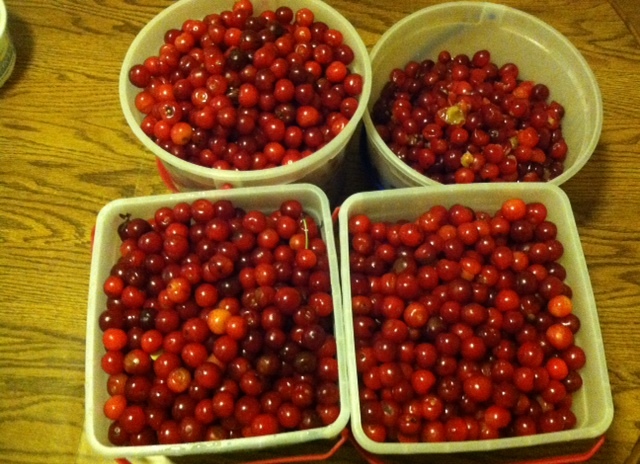
Recently my mom and I were able to pick cherries at our neighbors’ house.  While we were picking, some rain showers moved through the area leaving us wet but we had a gorgeous view of the end of a rainbow.

rainbow

I didn’t think to take the picture before I started pitting the cherries so one of these buckets has already been pitted.

cherries

Cherry Pie Filling Recipe

  • 7 quart pitted sour cherries
  • 6 cups sugar
  • 1 3/4 cup clear jel
  • 1 tsp cinnamon (optional)
  • 9 1/3 cup cold water
  • 1/2 cup lemon juice

Mix the sugar, Clear Jel® and cinnamon in large stock pot with a whisk.  Then add cold water.  Stir well.  Cook on medium high heat until begins to thicken. (continue stirring well!) Once it is thick and transparent add the lemon juice. Boil for one more minute. Then gently turn the cherries into the hot filling and return to a boil.  Then ladle the cherry pie filling into the prepared jars and process either in pressure canner or water bath.


Pressure Canning
Size Time 0-2,000 ft 2,001-4,000 ft 4,001-6,000 ft 6,001-8,000 ft
Quarts 10 minutes 6 psi 7 psi 8 psi 9 psi
Water Bath Canner
Size 0-1,000      ft 1,001-3,000 ft 3,001-6,000 ft Above 6,001 ft
Quarts 20 minutes 25 minutes 30 minutes 35 minutes

*Before canning please read the recommendations for your pressure canner!

I finished canning the cherries July 3 and ended up with 16 quart of cherry pie filling. Hooray!

Obviously I have been a little slow getting this post completed. Lately I haven’t had much time to blog but hopefully I can get caught up soon.

Blessings!

Jennifer


Posted in Preserving, Recipes | Tagged , | Leave a comment

My First Honeybee Cutout

Last Monday evening, I received a call from a local bee keeper who I have been learning more about bees from. He had been contacted by some local homeowners who had bees in the walls of their home. They wanted to have the bees removed in a process that is called a cut out. The bee keeper, Ted, told me that based on the number of bees that he had seen at the residence that there was a good possibility that I could fill the three Top Bar Hives that I had built. We made plans to meet the following evening at the home to begin removing the bees.

I had to modify my top bars in order to attach the comb that we would be removing. I came across this video, but since I didn’t have time for glue to dry I didn’t use any. I drilled 1/4″ holes in the top bars at an angle but the holes in the paint sticks I drilled straight. This put just enough pressure on the 1/4″ dowel rods that they were very secure.

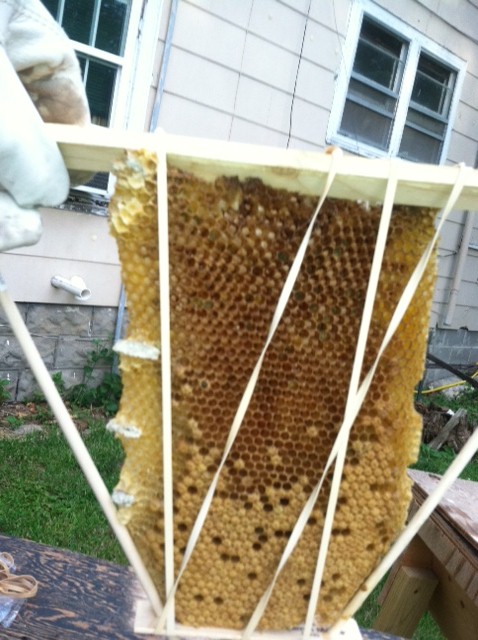
The homeowner used a sawzall to cut through the plaster and lathes. Ted then carefully removed the plaster and slowly began removing the lathes. The bees had attached the comb to the lathes; so when he removed the lathes, caution was necessary so that the comb wouldn’t be broken.

cut out 2The bottom of the comb had been cut by the sawzall. This comb is new comb. You can tell because it is so white looking.

cutout6cutout5As he removed the comb, Ted used the bee vac to remove the bees from the comb. I didn’t get a picture of the bee vac but basically it is like these plans. He cut the comb to fit in my frames. I then secured the comb by placing big rubber bands around the comb and frames. cutout 3

During the cut out, we found six capped queen cells like the one in this picture (top right corner of comb) We also found lots of capped brood (top middle of the comb) and capped drone cells (larger cells bottom middle). The cells that look shiny contain honey.

Since we found six capped queen cells we didn’t spend much time looking for the queen. I divided the three TBH into halves so that each of the queen cells would be in its own hive. I then divided the remaining comb evenly between the hives. When I got home, I poured the bees from the bee vac into the TBH as well. It was a little tricky to evenly divide the live bees, but hopefully I got them divided evenly enough that each of the hives will thrive.

I am so excited to have bees and to continue to learn about these magnificent pollinators!

Linked to:

monday's homestead barn hop

Posted in Bees, Homesteading, Top Bar Hives | Tagged , , | 2 Comments

A Calf is Born: A Birth Story in Pictures

This evening the heifer that Rebekah has picked as her favorite had her calf.  This is her birth story in pictures.

OLYMPUS DIGITAL CAMERA

Rebekah is watching as the heifer has the water bag out.

OLYMPUS DIGITAL CAMERA

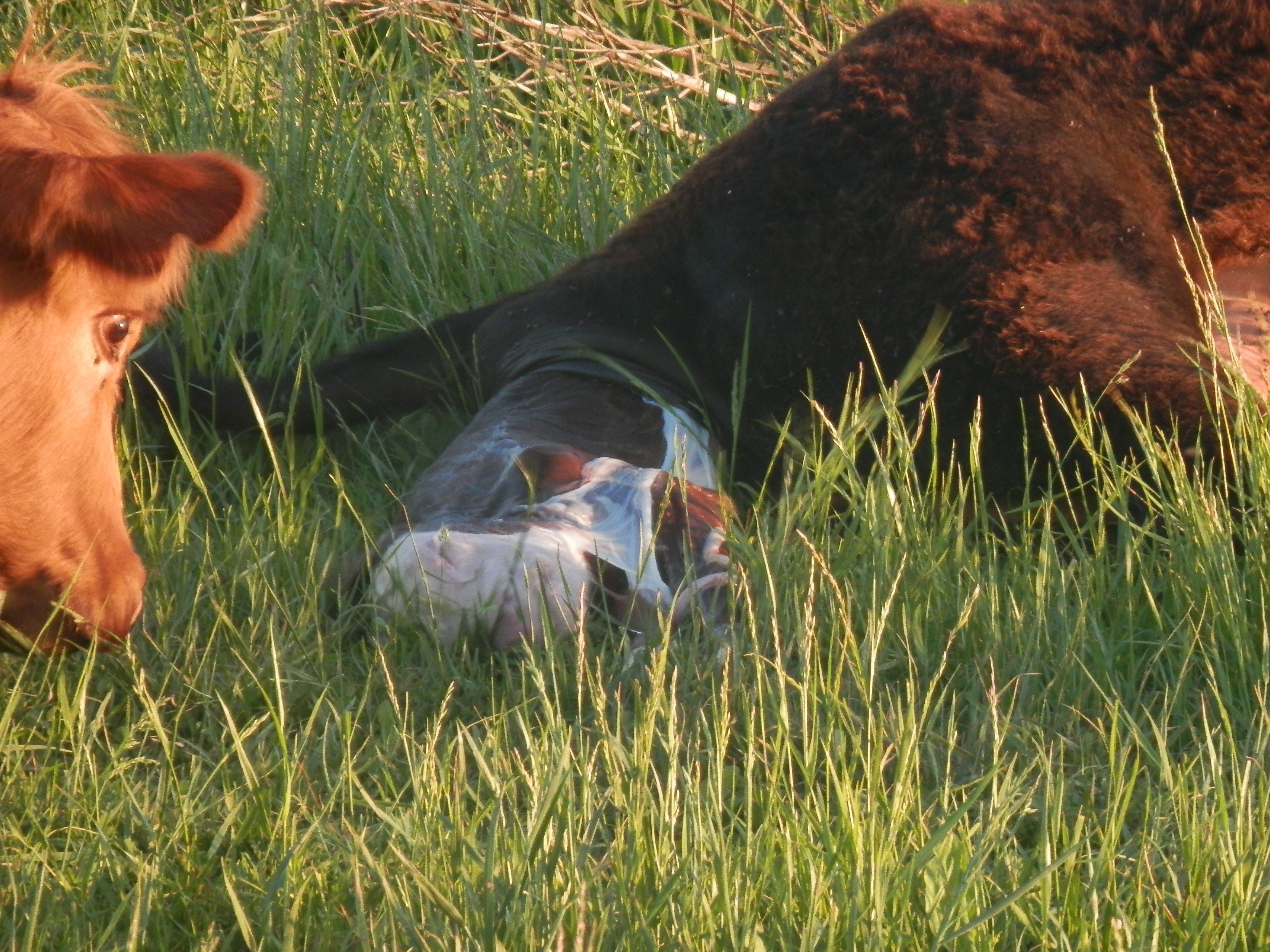
The water bag has just popped.

OLYMPUS DIGITAL CAMERA

Those are the front feet, this is good. The best position for a calf to come is both front feet first.

OLYMPUS DIGITAL CAMERA

The head is coming out.

OLYMPUS DIGITAL CAMERA

The shoulders are coming out.

OLYMPUS DIGITAL CAMERA

OLYMPUS DIGITAL CAMERA

The calf is all out and now the heifer takes about a minute to rest.

OLYMPUS DIGITAL CAMERA OLYMPUS DIGITAL CAMERA

The new momma starts licking her new baby. This serves two very important purposes 1) helps the calf dry off and 2) helps stimulate the calf to stand up.  It essential that the calf stand up and nurse within the first few hours of life

The new mama starts licking her new baby. This serves two very important purposes 1) helps the calf dry off and 2) helps stimulate the calf to stand up. It essential that the calf stand up and nurse within the first few hours of life

OLYMPUS DIGITAL CAMERA

Mama and baby are watching their audience. The kids were watching them. 🙂

OLYMPUS DIGITAL CAMERA

The baby is already trying to find a place to nurse. The first milk that the mama produces is colostrum.

OLYMPUS DIGITAL CAMERA

The placenta is hanging out. The mama will deliver it soon.

Rebekah was thrilled to be right beside me when the calf was born.  She has named the new little heifer calf “Thumper.”

The sun soon went down so I didn’t get any pictures taken of the calf standing.

Definitions:

  • Water bag: The fluid filled bag that comes out before the calf.
  • Heifer: A female cow that has not yet had a baby.
  • Colostrum: The first milk produced and it contains essential antibodies for the newborn baby.

We have been so blessed to be able to share this lifestyle with our kids!  It is so wonderful for them to be able to witness the miracle of life.  We are so thankful for God’s many blessings in our lives!

Blessings,

Jennifer

Linked to:

country fair blog party buttonThe Self Sufficient HomeAcre

Posted in Animals, Family | Tagged , , | 2 Comments