When Life Hands you… Open Cows

When we pregnancy checked our cows the day after Christmas we did not get good news.  Nearly 90% of our cows were called open.  UGH!!  This was a huge blow to us.  This meant that the calf crop we had counted on being born in May and June was simply not going to happen.
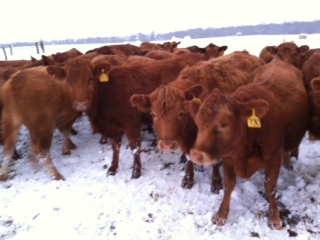
photo-4

We then had to decide what our next course of action was; were we going to sell them as open cows, put them in a feedlot and feed them out or try to breed them again.  We decided to get a different bull and try to breed the cows in hopes that the bull was the problem.

We turned a bull in with the cows for 60 days and then played the waiting game.  Thankfully we didn’t have to wait too terribly long as we decided to use Genex Blood Pregnancy Test to determine which cows were bred. Getting the results so quickly enabled us to go ahead and sell the cows that were now bred (90% of those that had previously been open) but had moved from calving in May/June to calving in late fall.

Selling those short bred cows gave us the opportunity to reinvest that money into a few other enterprises. In future posts, I look forward to telling you how we turned those “lemons into lemonade” or in this case open cows into ewes, cows and a hoop house.

At one time or another we will all be handed a bad situation, it is our attitude that determines how we will handle this.  Are we willing to turn lemons into lemonade?

Have a blessed day!

Jennifer

Linked to:


Country Fair Blog Partybarnhopimage

Posted in Animals | Tagged | Leave a comment

American Rabbits: Black, Blue and White Too

Over the course of a couple of months, we have been adding American Rabbits to our homestead.  The addition of the rabbits started when Eli and Rebekah asked to show rabbits at our county fair.  Although they are Clover Kids in 4-H and aren’t able to show in the actual rabbit show, they can take their rabbits in to the exhibition night and show them to the judges.  The kids have enjoyed the rabbits so much we have added more rabbits.  We now have four does (2 blue, 1 black and 1 white) and two bucks (1 blue and 1 white.)

OLYMPUS DIGITAL CAMERAWe chose American rabbits for a few different reasons.  When I was researching rabbit breeds this is what I read about Americans from the Breeders of American Rabbits website:

Not just a historical curiosity, the American is a good meat, fur and show rabbit. With some breeding care, the American can be a large and hardy animal, with large litters and fast weight gain potential. A good American is large and hard to ignore on the show table.

OLYMPUS DIGITAL CAMERAThe American Rabbits are listed as threatened on the American Breeds Conservancy which made them even more appealing to me.  I like the idea of helping to maintain a heritage breed.  They are also a very docile rabbit which is very important to me since the kids are the main caretakers.

OLYMPUS DIGITAL CAMERA

Although we have all three colors, only the blue and white are recognized colors for showing.  However, since Rebekah really wanted a black rabbit we have a black rabbit.  We are looking forward to having a few litters later this year.  It will be fun to see what colors we have.

Do you have rabbits? If so what is your favorite breed and why?

Blessings,

Jennifer

Linked to:

Country Fair Blog Party


Posted in Animals, Homesteading, Rabbits | Tagged , | 3 Comments

Raising a Dairy Bottle Calf

The kids and I decided that they would raise some Holstein calves. So in February, we got three bull calves ranging in age from 3 days to 2 weeks.  We picked up the calves during a bitterly cold stretch.  Within a few days, all three had a round of scours due to the weather and moving stress.

Each of the calves refused to take the bottle at some point while they were scouring. (Scours is diarrhea in calves and is an indication of an infection.  Like any diarrhea, dehydration is a concern if it is not corrected.)  When they refused to take the milk, I mixed up a bottle of electrolytes.  They willingly  took the electrolytes. We also gave them each a shot of an antibiotic to help them as well. The next feeding I reintroduced milk and they went back to taking it.

OLYMPUS DIGITAL CAMERA

Calf with scours

Since then the calves have been doing great!  We continued feeding them bottles twice a day for 8 weeks and then switched to bottle feeding them once per day.  We continued bottle feeding for two more weeks before we weaned them.  When we weaned them they were eating grain and hay very well.

OLYMPUS DIGITAL CAMERA

The calves now have access to grass and free choice hay in addition to being fed grain.

Feeding bottle calves is a lot of work but it is a great project for the kids.  Most of them enjoy the calves, in fact, we plan to get more calves for them to raise in the future.

If you are going to get any bottle calves it is very important that they receive colostrum during the first hours of life.  Colostrum is the mother’s first milk which is loaded with antibodies to help ensure the health of the calf.  If you buy calves, make sure that the breeders give ample colostrum to the calf before selling it.  Also, make sure that you have a high quality milk replacer to feed the calves.


Blessings,

Jennifer

Linked to:

Country Fair Blog Party

Posted in Animals, Homesteading | Tagged , , | 4 Comments

I Have Lard; Now What?

Now that I have rendered lard what am I going to do with it?  Well I’m glad you asked!

Here are a few of the ways that I have used lard:

  • in any recipe that calls for shortening.  It makes pastries and pies exceptionally flaky and delicious.
  • to deep fry in.
  • to make homemade soap.
  • and to season cast iron cookware

Here are some other uses for lard that I intend to experiement with:

  • making homemade candles with it.
  • making healing balms and salves for dry, cracked hands and feet.
  • and to mix it with beeswax to use on wood and leather as a preservative.

This blog post has some more uses for lard.

I also learned something new, lard from our outdoor pigs is also high in vitamin D.  Now that’s good news.  (Of course, it would stand to reason since raising them outside is healthier for the pigs, that their by-products would then be healthier for us.)

Do you use lard? Do you remember your parents or grandparents using lard?

My grandma has told me that when she was younger her family would butcher pigs and use basically everything except the squeal.  It is fun listening to how they processed the pigs to feed their family.  It is also interesting to note that this same family that ate lard, bacon etc lived to be an average age of 88.  Not too bad if you ask me.


Posted in Animals, Homesteading, Recipes | Tagged , , | 1 Comment

Lard Rendering For A Beginner

Saturday for the first time, I rendered lard. When we had our pig butchered, I had the butcherer save the fat trimmings for me. (This particular butcher no longer renders lard as they have little demand for it.)

Here’s how I did it:

The butcherer ground the lard for me which makes it melt quicker. If your fat trimmings aren’t ground, then cutting them in small pieces is is a good idea. I placed the lard in my electric roaster and set it on 250* F.

photo 2

photo 3

I spread the lard out so that it would melt more evenly.

Periodically I would lift the lid and stir it as it melted, because my roaster gets hotter near the edges than it does on the bottom.

photo 4

photo 5

You can see that as it melted the lard became transparent and the cracklings began to appear.  Once it had all melted, I used a slotted spoon to remove the cracklings.  After the cracklings were removed, I turned off the roast and let the lard begin to cool.  This took several hours, much longer than the melting took.  I ladled it into an ice cream bucket, when the lard had cooled to just above room temperature.

photo 8

I stilll have more lard to render but I am no longer intimidated about this job.  I kept putting off trying it because I was sure I would burn it or otherwise ruin it. I am so glad that I finally tried to render lard.

What task have you been putting off because you wonder if it will be too difficult?

This year I hope to become proficient on some new tasks that “I have always wanted to do.”  Won’t you join me?

Jennifer

Linked to:

barnhopimage

Posted in Homesteading | Tagged | 1 Comment